Despite my left leanings (I'm what you could call a "dissenting left-winger"), I love all things counterculture, taboo, and politically incorrect. I have a rather large interest in Satanism, more specifically the Anton Szandor LaVey variety, the Church of Satan. Straight from the mouth of Rev. Kevin Slaughter is a very concise introduction to the philosophy of the CoS. Although I don't agree with some statements (especially in part 5), Satanists almost always leave you with food for thought.
For the full video:
http://www.youtube.com/watch?v=PpI_TvJXc84
NOTE: I am not associated with the CoS, let alone consider myself a Satanist.
Wednesday, September 28, 2011

Monday, September 12, 2011
A Clip from "Happiness"
Not only is Todd Solondz's "Happiness" one of my favorite movies, it's also one of the few films where you will see Jon Lovitz in a serious role.
Friday, April 15, 2011
Saturday, April 2, 2011
Sunday, March 6, 2011
"Mommy Mommy Where's My Brain?"
A cool short from 1986 by Jon Moritsugu. The underground doesn't make them like this anymore...
Tuesday, February 22, 2011
Star Trek on Religion
I'm not really a Star Trek fan; I don't think I've seen one episode. But the man has a point dammit!
Sunday, January 23, 2011
Tuesday, January 18, 2011
Trash Humpers

After having viewed Larry Clark's Kids about four years ago, I had hankering for more. I perused Clark's Wikipedia and IMDB pages, seeing such titles as Wassup Rockers and Bully. Strangely enough, it would be another two years before seeing another Larry Clark film. I found Bully on recorded on DVR at my parents house and I could not pass it up. Why wait two years to see another Clark porno? Because Kids writer Harmony Korine caught my eye, and I found the descriptions of his body of work (as of 2007) a bit more fascinating. His style of filmmaking blurs the lines between art and exploitation, not unlike early John Waters' films.
 Korine's directorial debut, Gummo, was quite the introduction, as I had never seen anything like it. Where Kids was a portrait of teenage debauchery on overdrive, Gummo took it to a more nihilistic and bleak level, following the lives of teenagers in a small town in Ohio that was left in ruins by a tornado. Despite the fact that I find most people hating this movie, I'm not ashamed to say this film definitely makes my top 20 favorite films. His next effort, Julien Donkey-Boy, was an intriguing study of a mentally disabled man with schizophrenia, and had a macabre beauty in its ugliness. It was a Dogme95 production (some have put this up for debate), and Korine makes the film wonderfully surreal despite the limitations. Mister Lonely was a major departure from Korine's depressing realism, as it had a bigger budget and a concept that could not rely on Korine's knack for creating narratives out of barely outlined scripts. Mister Lonely is two stories; one is about a Michael Jackson impersonator that finds a home on a commune populated by other celebrity impersonators, and the other is about a priest (played by legendary filmmaker Werner Herzog) and his nuns on a mission in a Third World country. It is not his best work, but still a worthy addition to his body of work.
 And in 2009, there was Trash Humpers. In what you could call a 'return to form' for Korine, the realism is accentuated by his use of a VHS camcorder. Humpers is about a gang of vandals in 'old people' masks (one of them actually looks like the bastardized version of Freddy Krueger in the recent remake) that roam the alleyways and disenfranchised streets of Nashville, busting television sets and fluorescent lightbulbs, setting off firecrackers, and yes, humping trash cans, among other things. From all this comes some what of an "accidental narrative", as the characters find a bit of redemption in the end, going from almost completely free individuals living on the fringe to finding a little bit of domestication. Not unlike the idea behind the visual style of August Underground, the film is made to look like someone's home movies that is found lying in the gutter and discovered by a curious person. It works on this level, as even the film's credits are produced by the title function on those old VHS camcorders.
 With that said, I must admit that Trash Humpers was a minor disappointment. It had all the right factors going for it: realism, a gritty aesthetic, a group of people that have no boundaries, and Korine's unique direction and improvisation. But what weighs it down is its repetitiveness and lack of structure. Most of the scenes are comprised of breaking shit, high-pitched laughter, humping a stationary object or masturbating a long cylindrical object, and the camera man singing the same jingle ("Three little devils jumped over the wall, chopped off their heads and murdered them all"). Even though a lack of structure has worked for Korine's films in before, it works to both advantage and disadvantage here. It serves the aesthetic well, but this also makes scenes awkward, with the camera capturing gaps in conversations when the scene's purpose has been fulfilled and the actors don't know what else to say.
Despite its flaws, it is not a bad film. There are some amusing moments, and watching people that just don't give a fuck and enjoy mayhem always serves some degree of catharsis for the viewer. And there are moments that you don't see coming. But three-minute scenes of 'old men' humping trees and simply laughing at the camera bring it down. So much more could have been down with this premise, but it doesn't go as far as it should. Still, it has a nightmarish quality to it, with a nihilistic and foreboding undertone to it not unlike Gummo. The world these deviants live in is an American landscape that has been left in ruin and the disenfranchised live on the existing pieces. Like his other films, they are most likely only to be appreciated by his already existing fan`base, and hated by everyone else. I just hope that Korine's next film will embody his potential more than this one did.
See the trailer.
Thursday, December 9, 2010
Are Christians the New Persecuted?
I think it'll only be a matter of time before the ridiculous and intentionally ignorant Christians in America begin to akin their situation to that of blacks in the 1960s South.
Monday, September 20, 2010
Thursday, September 9, 2010
Niku Daruma
 On the fringes of cinema, there have always been films that push the boundaries of what society has deemed decent and acceptable for the public to view. Such films depict graphic violence, unsimulated sex, and other taboos that regular people dare not speak of, with some movies including all of the above. Here in the United States, films like August Underground and Faces of Death gain an audience in the underground circuit and obtain recognition mainly through notoriety and word-of-mouth. But across the Pacific, Japan has its own brand of extreme cinema, with an emphasis on combining both pornography and unapologetically brutal violence. Niku Daruma (aka Tumbling Doll of Flesh or Psycho: The Snuff Reels) is such a film, even though it may seem tame to fans of extreme movies.
The film begins in a dark room, with a man sitting watching the gorey aftermath of an ax homicide on a small television set (according to many other movies about psychopaths, this is shown to establish his craziness). Next, we are shown several men picking up a female porn star, and they are taking her to the set (aka some guy‘s shitty apartment). The scene they are shooting gradually becomes more extreme, as they start off with normal foreplay and move into rope-bondage. It is when they introduce her to an enema that she objects and wants to take a break. While going to the restroom, one of the men come in and beat her over the head with a baseball bat. The three men tie her to the bedposts with ropes, and proceed to perform multiple amputations and other graphic acts (which would lose their impact with curious readers if I mention them).

Niku Daruma is directed by Tamakichi Anaru (his surname actually translates to “anal”, which is very telling, considering Niku), who has made other gore-soaked fares as Suicide Dolls and Women’s Flesh: My Red Guts. He is also known for his pornographic work, with such titles as Mother and Daughter: Spit-Swapping Seduction and Near Relation Lesbian Kiss. Anaru no doubt has a peculiar taste when it comes graphic sexuality, and he incorporates this into Niku and has the narrative (or lack-there-of) take a violent turn for the worse in this respect. Although he does, in a way, cater to the wishes of gorehounds and fans of obscure extreme cinema, Anaru has clearly made this film just for the sake of being shocking and perverse.
I must admit, I expected more going into this film. Having read other reviews for Niku, I was awaiting the chance to be shocked and disturbed. However, what I got was a 69-minute film that was a 40-minute porno (a rather boring one at that) and a 20-minute faux snuff film. I probably would not have minded this, were it for how painfully long and unnecessarily tedious the snuff portion of the film was. It also did not help that there were no subtitles, which makes you care about the characters even less. Niku Daruma has a very limited release here in the United States, and can probably only be found on eBay or the darkest corners of the internet. If you are into this sort of movie and you have a morbid curiosity to see it, then go for it (if you can find it). But Niku Daruma is too painfully long considering its short running time and has incredibly sub-par effects that I cannot actually recommend it to anyone.
Wednesday, September 1, 2010
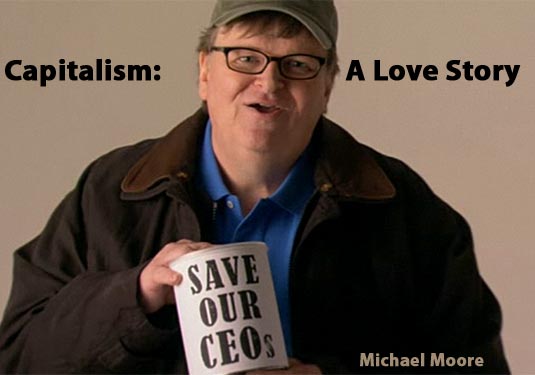
Capitalism: A Love Story
 The always controversial documentarian Michael Moore has been exposing the corruption, greed, and down-right inconsideration for the lower and middle class of America's elite for over twenty years now. Since the people who tend to support the actions and ideology behind the upper one percent are on the right side of the political fence, Moore has attacked the very basis for their position in Capitalism. Moore has even expressed that this is the film that he has been waiting to make since the beginning of his career (I'm paraphrasing). This is highly evident, as the problems of capitalism have been an underlying but influential factor in the issues discussed in his movies, even if he hasn't previously came right out and said it.
  Within the first twenty minutes, there is a montage of old-time circa-1950s footage, showing clips of the idealized yet unrealistic view of the nuclear family's American dream: dad working a factory job, mom shopping with a baby sitting in the shopping cart, the family on vacation. Over this, the narration states how things used to be good in the old days, when dad had a job that provided the family with everything they needed, mom could "work if she wanted to but didn't have to", and the middle class had a "love affair with capitalism". But soon enough, he mentions that not everything was perfect, and as long as people got to live the American dream, they would put up with "this and that", while showing clips of black men being hosed down and bombs being dropped. This is one of the more confusing parts of the film, in that I am not quite sure of what Moore is getting at. If this is the ideal version of capitalism, in which dad's job was enough to support a family and provide for their basic needs, then does he support this kind of economic system? Although he does show that things were not great for minorities and countries we had invaded at the time, this is somewhat overshadowed by the assertion that this capitalism was perverted when Reagan came into office. Moore comes dangerously close to insinuating that the 50s and 60s was a better time in American history, much like how conservatives think this was a time where family values, work ethic, and adherence to morals was at its peak, and we should therefore return to that mentality. But what they always fail to mention is the lack of rights and recognition that minorities, women, and even gays had, and this system really only benefited white middle-class males.*
My biggest bone to pick with Capitalism, and Moore specifically, is a religious aspect that incorporates in the film. He interviews several priests, who claim that capitalism is an evil and use words like "eliminate" and "eradicate" in relation to capitalism and its supporters. Christianity is supposedly highly altruistic, always looking out for the better interests of the collective, and enterprise and greed are antithetical to Jesus' principles. Moore even claims that he wanted to be a priest, but he saw them as activists pushing for social reform. First of all, I find it strange that Moore only interviews Catholic priests. I find this ironic that they are put into this context of being the ones who support the lower class, when the Vatican is a very wealthy city-state, and the reason priests can't marry has historically been because their property would go to their families instead of the Church. That sounds a lot like a product of capitalism to me. I do understand that these priests are a minority, much like the few white churches that helped out during the Civil Rights movement and the anti-war protests during the Vietnam War. But Christianity, and any other religion for that matter, has never been the poster child for social progress and reform**. Time has showed us that Christianity has consistently clung to tradition and a contradictory value system that is slowly changed in terms of peripheral beliefs as a modern world demands reform. So Moore saying that the teachings of Christianity has been at the forefront of fighting for reform and the average worker is fallacious, especially when homosexuality, a woman's right to her body, and even contraception and condoms are still condemned by most denominations. Moore fails to acknowledge the Christian/imperialist complex that is at work in America, and that he has been blaming for the past twenty years.
 However, these problems occur in the first half of the two-hour plus film. After an hour of anecdotal cases of home foreclosure and seizure, mild religious pandering, and personal stories, he finally gets to the real issue that is on everyone's mind: the financial crisis. Chronicling the beginning of the real estate loan scam that eventually and tragically ended up crashing the economy, Moore doesn't hesitate to point fingers. This is no doubt the most powerful and enraging part of the documentary, in that it shows a corporatist scam that was flawed and rotten from its very foundation.
Aside from the few problems I aforementioned, this is a compelling documentary that Moore has been working towards his whole career, whether he realizes it or not. It may not be the smoking gun that the left has been waiting for to start what the right refers to as a "commie revolution", but it will no doubt get people thinking, even if they their concern ceases the beginning of the next work day. While exposing the corruption that capitalism can potentially (and maybe even eventually) lead to, he simultaneously calls for major economic reform, namely a form of socialism, even if he doesn't say it out loud. If you hold onto the idea that America is 'great' because of capitalism, or that God wants it this way and the only alternative is a communist/socialist police state that persecutes Christians and is run by Jewish, Satanic, Catholic, homosexual, feminist, occultist, atheist (or maybe even aliens or lizards) bankers bent on world domination and destruction, then this will either enrage you or change your mind.
But I couldn't help but wonder what will become of Michael Moore now? He even states at the end of the documentary that he doesn't think that he can do this anymore. His reputation has gotten him to the point where he can no longer walk into the lobby of GM Headquarters and try to make an appointment with the CEO, like he did in Roger and Me. The second time around, in Capitalism, a security guard walks right up to him and the camera, trying to cover the lens with his hand while immediately recognizing Moore and telling him he can't shoot without permission. For Mike, it has gotten to the point where every white collar worker knows who he is and is constantly looking out for him, because of the attention he attracts and the influence he may have.
 Maybe it is time for him throw in the towel, or at least get into producing and support like-minded people looking for social justice. Or maybe he can rip the next Republican president a new asshole while making the Weinsteins a shitload of money because they think his films won't cause an uprising within a population that is largely apathetic, numbed out on trash television, and whores of the system. But with a capitalist society like ours, can you blame them for the lack of optimism?
*- This is not an admission of white guilt, nor am I saying that no white males get screwed over by capitalism
**- Again, there are always exceptions, and there is a minority that is progressive and has 'gotten with the times'
Monday, May 10, 2010
SCHLOCK! The Secret History of American Movies

What exactly does an exploitation film exploit? Is the marketing of a shitty film as a good one? Is it the use of titillating subject matter that will no doubt put some asses in the seats? Is it the name of a star that will draw attention to the film? Or is it the cast and crew, who are looking for film credits to further their career but are stuck on a low budget exploitation film that will pay them little to no money? The answer probably lies in a combination of several of these questions, if not all.
SCHLOCK! The Secret History of American Movies is a documentary directed by Ray Greene. It takes a look at the beginnings of the exploitation film, that were mostly science fiction fare like Invasion of the Saucer Men, back when science fiction was lumped in with pulp magazines. It shows the progression of how exploitation films were always looking for new material use, especially as the sexual revolution of the late 60s and 70s made people more curious about who's fucking who. The documentary features a handful of the pioneers and early players including Doris Wishman, Samuel Z. Arkoff, David F. Friedman, and the legend Roger Corman.
The problem with this feature is that has a fascination with sex. Starting off with sci-fi, it continues into the early Roger Corman horror movies, like The Terror, and his numerous Edgar Allan Poe adaptations with Vincent Price. OK, so far so good. Then it delves into the nudie film, a precursor to sexploitation films, in which relatively normal dramas and comedies take place in nudist colonies. It was subversive for the time, but since nudist colonies actually existed, they were able to get through the censors (and sex doesn't actually exist?). This eventually evolved into what are called "roughies", which focused on sex that varied from slightly rough to rape. It was around this time that I figured the documentary wouldn't get any better. Ten minutes prior, which was the fifty minute mark of a ninety minute film, they mentioned Herschell Gordon Lewis. You can imagine my disappointment when I thought they would finally stop dragging out the sexploitation concept and finally talk about the movies I wanted to hear about, the utterly twisted, depraved, gorey, and disturbing ones. Where the fuck is my Cannibal Holocaust? I Spit On Your Grave? Jesus Christ, my fucking TROMA!!!
I would have liked this more if covered anything past the early seventies, when exploitation was at its height. Having interviewed mostly directors and producers that worked in sexploitation, they most likely figured it was the easiest way to have interview footage and access to film stock that would fill up a 90-minute running time. Although disappointing, it does has some good insights. I was surprised to see Peter Bogdanovich, who played Dr. Melfi's therapist on The Sopranos, and worked with Roger Corman and Francis Ford Coppola as well as direct some movies. Probably the best insight came from Harry H. Novak (I think) who asked "What movie made today isn't an exploitation film?", which is juxtaposed to a shot of a billboard advertising Pepsi and Star Wars Episode 1 with Jar Jar Binks holding a can. Need I say more?
SCHLOCK! The Secret History of American Movies is a documentary directed by Ray Greene. It takes a look at the beginnings of the exploitation film, that were mostly science fiction fare like Invasion of the Saucer Men, back when science fiction was lumped in with pulp magazines. It shows the progression of how exploitation films were always looking for new material use, especially as the sexual revolution of the late 60s and 70s made people more curious about who's fucking who. The documentary features a handful of the pioneers and early players including Doris Wishman, Samuel Z. Arkoff, David F. Friedman, and the legend Roger Corman.
The problem with this feature is that has a fascination with sex. Starting off with sci-fi, it continues into the early Roger Corman horror movies, like The Terror, and his numerous Edgar Allan Poe adaptations with Vincent Price. OK, so far so good. Then it delves into the nudie film, a precursor to sexploitation films, in which relatively normal dramas and comedies take place in nudist colonies. It was subversive for the time, but since nudist colonies actually existed, they were able to get through the censors (and sex doesn't actually exist?). This eventually evolved into what are called "roughies", which focused on sex that varied from slightly rough to rape. It was around this time that I figured the documentary wouldn't get any better. Ten minutes prior, which was the fifty minute mark of a ninety minute film, they mentioned Herschell Gordon Lewis. You can imagine my disappointment when I thought they would finally stop dragging out the sexploitation concept and finally talk about the movies I wanted to hear about, the utterly twisted, depraved, gorey, and disturbing ones. Where the fuck is my Cannibal Holocaust? I Spit On Your Grave? Jesus Christ, my fucking TROMA!!!
I would have liked this more if covered anything past the early seventies, when exploitation was at its height. Having interviewed mostly directors and producers that worked in sexploitation, they most likely figured it was the easiest way to have interview footage and access to film stock that would fill up a 90-minute running time. Although disappointing, it does has some good insights. I was surprised to see Peter Bogdanovich, who played Dr. Melfi's therapist on The Sopranos, and worked with Roger Corman and Francis Ford Coppola as well as direct some movies. Probably the best insight came from Harry H. Novak (I think) who asked "What movie made today isn't an exploitation film?", which is juxtaposed to a shot of a billboard advertising Pepsi and Star Wars Episode 1 with Jar Jar Binks holding a can. Need I say more?
Thursday, March 25, 2010
Jesus Ranch
Here's a clip from the not so well known and very mediocre (I remember seeing the boom mic come into the shot on several occasions) film Bongwater from 1997. Even though Jack Black is featured prominently on the main cover art for the flick, he appears in it for less than ten minutes. But goddammit do I love when he's in it. This is also one my favorite Tenacious D songs.
PS- Believe me, the song makes more sense in the context of the Tenacious D HBO episode.
PS- Believe me, the song makes more sense in the context of the Tenacious D HBO episode.
Sunday, February 7, 2010
Atheist Quiz
I don't invest much faith in these type of quizzes, but they sure do help waste time quite nicely.


Thursday, October 29, 2009
Clerks. Analysis
This is a paper I wrote for a film course in college. The writing is not as good as it could be, but trust me, I've become better at it since then. I like it because it is a completely formalist criticism. I know that the themes I found in Clerks. were not any part of Kevin Smith's authorial intent, as evidenced by several of his SModcast episodes. Regardless, this is my analysis of Kevin Smith's-in my opinion-magnum opus:
"I'm not even supposed to be here today!": Slackerdom and Clerks.
Kevin Smith’s 1994 debut feature film Clerks tells the story about two clerks that work in a convenience store, referred to as the “Quick Stop”. Called in on his day off, Dante (Brian O’Halloran) is forced to deal with annoying customers, his two love interests, and his best friend Randal (Jeff Anderson). He is also forced to take a look at his life and where it is going, or if it has any direction at all. Roger Ebert describes the movie and its characters as: “The movie has the attitude of a gas station attendant who tells you to check your own oil…and Dante and Randal look like they have been nourished from birth on beef jerky and Cheetos. They are tired and bored, underpaid and unlucky in love, and their encounters with customers feel like a series of psychological tests” (Ebert par.2).
Smith’s focuses on the main two losers throughout the film, of whom are perfect examples of the slacker culture of the early nineties. Desson Howe of the Washington Post said, “much of ‘Clerks’ is extremely funny and dead-on—in terms of its intentionally satirical, Gen-X-istential gloom” (Howe par.3). Dante and Randal are both adults in their early twenties, while still working at the Quick Stop and showing no signs of improving or changing their situations. Dante complains repeatedly about his life, mostly saying: “I’m not even supposed to be here today!” throughout the film, without doing much about it. But on the other hand, Randal is content with his situation, and simply deals with every day brings. By focusing on their personalities and overall attitudes, Smith presents a message of getting on with life, despite the life situation.
Clerks’ structure doesn’t possess a plot, but rather shows events throughout the course of the day. It plays more like a series of occurrences that ultimately tie together the day depicted and the film itself. Some scenes are merely conversations about Star Wars, stupid customers, and porn, while most of them progress the relationships of the characters. But they all add perspective to the characters’ personalities and the setting.
In terms of technical innovations, the film does not break any new ground. It was filmed in black and white, while many films at the time were not. The film’s budget was made for approximately $28,000, and was shot mostly in and around the real Quick Stop convenience store. Marc Savlov of the Austin Chronicle described the look of the film as “resolutely low-budget, full of shaky camera work, the occasional less-than-perfect edit, and a few sound glitches. Conveniently, though, all this shoestring filmmaking technique only adds to the film's desperate charm” (Savlov). As most of the movie is indoors, you get a feel for what they have to do all day, which is either dealing with customers or doing nothing. The cinematography is pretty straight forward, with the main use of objective point-of-view. But at the same time, Smith uses a director’s interpretive point of view. For example, there are many conversations between the two leads that take place behind the counter of the store. Smith frames the shot in a way so it is centered on the two standing behind the counter. This creates a feeling of them being trapped, because they are enclosed in that area by the counter, the wall behind them, and the consumer products that surround them. The camera movements are also pretty straight forward, as no pans, tilts, dolly shots, etc. are notably used. However, Smith does use a lot of handheld camerawork, except on the occasions on the mentioned counter shots.
Smith communicates two problems of the slacker culture: those who are satisfied with their life, and those complain but don’t do anything (or as Randal says to Dante towards the end of the film, those who “need to shit or get off the pot.”). Smith doesn’t only show this through the personalities of Dante and Randal, but through relationships. Dante is torn between two women: one is his current girlfriend named Veronica (Marilyn Ghigliotti) who truly loves him but pressures him to continue his education in college, and the other is a promiscuous woman he went out with in high school named Caitlin (Lisa Spoonhauer). Veronica is the driving force that could move Dante’s life into a new, successful direction, while Caitlin represents his high school days, before he entered the real world. This presents the conflict of whether Dante should stay where he is at in life with an old high school sweetheart (who has cheated on him in the past), or move on in life with the woman who wants him to succeed and loves him. By the end of the film, Dante’s relationships with both of them are ended, and Smith does not give much of an answer for whether Dante learned anything from them. But the film as a whole works in a weird way because of it, in that Dante himself doesn’t really know what he wants from life throughout the film, so by not giving him an epiphany or resolution compliments his persona very well.
What Smith seems to illuminate about our culture is the alarming rate of youth adults fit into the slacker category. Over the course of the film Dante and Randal are not the only characters without higher education. Outside the Quick Stop are two stoner drug dealers, named Jay and Silent Bob (two characters that show up frequently in Kevin Smith’s other films), who just simply stand in front of the store all day, waiting for their next drug deal. Not only does Clerks shine light on said slackers, but it also shows what it is like for those in the service industry. The clerks have to deal with stupid customers that ask them questions like: “How much does this cost?” (When there is a sign that reads “$.99”) and “What do you mean no ice, you mean I gotta drink this coffee hot?” At one point in the film, while Dante, Randal, and a customer are talking about a man that puts eggs through ‘endurance tests’ in the back aisle, she turns to them and says: “You see, it’s important to have a job that makes a difference boys. That’s why I manually masturbate caged animals for artificial insemination.” Several customers like this take an arrogant verbal stab at the clerks throughout the film, and you feel bad for them, despite their inaction to change their position.
This movie reminded my own experiences and me a lot of the people I know. Very few people in my own have gone to college, and have ended up in either construction-type jobs or service jobs of some kind. Also, many people I knew in high school who are not in college now are working as waiters or store clerks. I have worked several public service jobs, from hauling kegs and serving beer to bringing old people their food in a nursing home. And since I know what it is like to work in the service industry, there is a reason I am in college right now. Clerks changes the way you look at people stuck in those type of jobs, and the way you treat them. As Mick LaSalle of the San Francisco Free Press puts it, “there's something about seeing life from the distinct angle of the convenience-store clerk that's just new enough to hold you” (LaSalle par.7).
What makes the film work is that it chronicles a day in the life of Dante and Randal, rather than giving you bits and pieces of different days and time periods. By doing this, it gives the audience more of perspective of what these people go through, even if it be dealing with personal problems or fighting boredom. With all this said, I love this film. The dialogue is very realistic and funny, and like I said, I can relate to it even though I have never worked in a corner convenience store. There is a charm to the amateurism and simplicity of the story, and the intelligence behind the dialogue. However, I don’t think this film is for everyone. Despite the rave reviews it received at its theatrical release, Clerks is highly profane. Not only does it have many bad four-letter words, but there is also a lot of sexually explicit dialogue. Clerks initially received an NC-17 rating, and had to be edited down to get an R-rating. When a major plot point involves Dante finding out about Veronica and a large amount of fellatio on her part, you know that it’s profane. Only those who can handle almost constant profanity, but no violence or actual sex can dig this film. To really get the true idea of everything I mentioned, one has to see it for him/herself.
LaSalle, Mick. Clerks. 8 Nov 1994 San Francisco Free Press 4 May 2008.
http://www.well.com/conf/media/SF_Free_Press/nov8/clerks.html
Savlov, Marc. Clerks. 11 Nov 1994 The Austin Chronicle 5 May 2008.
http://www.austinchronicle.com/gyrobase/Calendar/Film?Film=oid%3a138414
"I'm not even supposed to be here today!": Slackerdom and Clerks.
Kevin Smith’s 1994 debut feature film Clerks tells the story about two clerks that work in a convenience store, referred to as the “Quick Stop”. Called in on his day off, Dante (Brian O’Halloran) is forced to deal with annoying customers, his two love interests, and his best friend Randal (Jeff Anderson). He is also forced to take a look at his life and where it is going, or if it has any direction at all. Roger Ebert describes the movie and its characters as: “The movie has the attitude of a gas station attendant who tells you to check your own oil…and Dante and Randal look like they have been nourished from birth on beef jerky and Cheetos. They are tired and bored, underpaid and unlucky in love, and their encounters with customers feel like a series of psychological tests” (Ebert par.2).
Smith’s focuses on the main two losers throughout the film, of whom are perfect examples of the slacker culture of the early nineties. Desson Howe of the Washington Post said, “much of ‘Clerks’ is extremely funny and dead-on—in terms of its intentionally satirical, Gen-X-istential gloom” (Howe par.3). Dante and Randal are both adults in their early twenties, while still working at the Quick Stop and showing no signs of improving or changing their situations. Dante complains repeatedly about his life, mostly saying: “I’m not even supposed to be here today!” throughout the film, without doing much about it. But on the other hand, Randal is content with his situation, and simply deals with every day brings. By focusing on their personalities and overall attitudes, Smith presents a message of getting on with life, despite the life situation.
Clerks’ structure doesn’t possess a plot, but rather shows events throughout the course of the day. It plays more like a series of occurrences that ultimately tie together the day depicted and the film itself. Some scenes are merely conversations about Star Wars, stupid customers, and porn, while most of them progress the relationships of the characters. But they all add perspective to the characters’ personalities and the setting.
In terms of technical innovations, the film does not break any new ground. It was filmed in black and white, while many films at the time were not. The film’s budget was made for approximately $28,000, and was shot mostly in and around the real Quick Stop convenience store. Marc Savlov of the Austin Chronicle described the look of the film as “resolutely low-budget, full of shaky camera work, the occasional less-than-perfect edit, and a few sound glitches. Conveniently, though, all this shoestring filmmaking technique only adds to the film's desperate charm” (Savlov). As most of the movie is indoors, you get a feel for what they have to do all day, which is either dealing with customers or doing nothing. The cinematography is pretty straight forward, with the main use of objective point-of-view. But at the same time, Smith uses a director’s interpretive point of view. For example, there are many conversations between the two leads that take place behind the counter of the store. Smith frames the shot in a way so it is centered on the two standing behind the counter. This creates a feeling of them being trapped, because they are enclosed in that area by the counter, the wall behind them, and the consumer products that surround them. The camera movements are also pretty straight forward, as no pans, tilts, dolly shots, etc. are notably used. However, Smith does use a lot of handheld camerawork, except on the occasions on the mentioned counter shots.
Smith communicates two problems of the slacker culture: those who are satisfied with their life, and those complain but don’t do anything (or as Randal says to Dante towards the end of the film, those who “need to shit or get off the pot.”). Smith doesn’t only show this through the personalities of Dante and Randal, but through relationships. Dante is torn between two women: one is his current girlfriend named Veronica (Marilyn Ghigliotti) who truly loves him but pressures him to continue his education in college, and the other is a promiscuous woman he went out with in high school named Caitlin (Lisa Spoonhauer). Veronica is the driving force that could move Dante’s life into a new, successful direction, while Caitlin represents his high school days, before he entered the real world. This presents the conflict of whether Dante should stay where he is at in life with an old high school sweetheart (who has cheated on him in the past), or move on in life with the woman who wants him to succeed and loves him. By the end of the film, Dante’s relationships with both of them are ended, and Smith does not give much of an answer for whether Dante learned anything from them. But the film as a whole works in a weird way because of it, in that Dante himself doesn’t really know what he wants from life throughout the film, so by not giving him an epiphany or resolution compliments his persona very well.
What Smith seems to illuminate about our culture is the alarming rate of youth adults fit into the slacker category. Over the course of the film Dante and Randal are not the only characters without higher education. Outside the Quick Stop are two stoner drug dealers, named Jay and Silent Bob (two characters that show up frequently in Kevin Smith’s other films), who just simply stand in front of the store all day, waiting for their next drug deal. Not only does Clerks shine light on said slackers, but it also shows what it is like for those in the service industry. The clerks have to deal with stupid customers that ask them questions like: “How much does this cost?” (When there is a sign that reads “$.99”) and “What do you mean no ice, you mean I gotta drink this coffee hot?” At one point in the film, while Dante, Randal, and a customer are talking about a man that puts eggs through ‘endurance tests’ in the back aisle, she turns to them and says: “You see, it’s important to have a job that makes a difference boys. That’s why I manually masturbate caged animals for artificial insemination.” Several customers like this take an arrogant verbal stab at the clerks throughout the film, and you feel bad for them, despite their inaction to change their position.
This movie reminded my own experiences and me a lot of the people I know. Very few people in my own have gone to college, and have ended up in either construction-type jobs or service jobs of some kind. Also, many people I knew in high school who are not in college now are working as waiters or store clerks. I have worked several public service jobs, from hauling kegs and serving beer to bringing old people their food in a nursing home. And since I know what it is like to work in the service industry, there is a reason I am in college right now. Clerks changes the way you look at people stuck in those type of jobs, and the way you treat them. As Mick LaSalle of the San Francisco Free Press puts it, “there's something about seeing life from the distinct angle of the convenience-store clerk that's just new enough to hold you” (LaSalle par.7).
What makes the film work is that it chronicles a day in the life of Dante and Randal, rather than giving you bits and pieces of different days and time periods. By doing this, it gives the audience more of perspective of what these people go through, even if it be dealing with personal problems or fighting boredom. With all this said, I love this film. The dialogue is very realistic and funny, and like I said, I can relate to it even though I have never worked in a corner convenience store. There is a charm to the amateurism and simplicity of the story, and the intelligence behind the dialogue. However, I don’t think this film is for everyone. Despite the rave reviews it received at its theatrical release, Clerks is highly profane. Not only does it have many bad four-letter words, but there is also a lot of sexually explicit dialogue. Clerks initially received an NC-17 rating, and had to be edited down to get an R-rating. When a major plot point involves Dante finding out about Veronica and a large amount of fellatio on her part, you know that it’s profane. Only those who can handle almost constant profanity, but no violence or actual sex can dig this film. To really get the true idea of everything I mentioned, one has to see it for him/herself.
LaSalle, Mick. Clerks. 8 Nov 1994 San Francisco Free Press 4 May 2008.
http://www.well.com/conf/media/SF_Free_Press/nov8/clerks.html
Savlov, Marc. Clerks. 11 Nov 1994 The Austin Chronicle 5 May 2008.
http://www.austinchronicle.com/gyrobase/Calendar/Film?Film=oid%3a138414
Wednesday, September 23, 2009
How to Pick Up Children the Evangelical Way
If you looked out your window and saw man talking to your kids from his car pulled up to the curb, what would you think? Personally, I'd think that someone I didn't know was trying to coerce my children into his car. But I'm sure an Evangelical would have no problem with a fellow Bible thumper proselytizing to his children. Not only does he try to convert these kids, but he makes them accept Jesus, whether they want to or not.
To be fair, this guy doesn't target only children. If you see his other videos on his YouTube channel, he also ambushes old ladies in supermarkets and bothers fast-food employees.
He's obviously taken notes from Ray Comfort and Kirk Cameron, who have perfected the art of pushing their beliefs on unsuspecting people on the street by asking them "Do you think your going to heaven?". Then they precede to probe them for the tiniest sins committed and damn them to hell in the next breath.
Maybe it's time for atheist to take the next step up from bus signs to asking believers that come out of church why they're so delusional.
Friday, August 7, 2009
My Place on the Political Spectrum
I've been bored today, so I decided to waste time on taking several online quizzes that tell you where you stand on the political spectrum. Rather than the do the oversimplified "Are you a Democratic or a Republican?" quizzes that one can find on Quizilla and the like, I went for ones that have the four-quadrant political compass- liberal and conservative, authoritarian and libertarian.


As you can see, not much of change in any of them. They all seem to point to the idea that I'm a Liberal Libertarian. These types of quiz tend to be of better use and have a little more credibility than tests that only tell you whether your a Democrat or a Republican. I don't know if the majority of the country knows this, but there is such a thing as a Third Party. And surveys like this can help find a party or candidate that actually fits their point of view.
To find out more about how the old "liberal vs. conservative" spectrum doesn't work, watch this. I am not a self-proclaimed Libertarian like the dude in the video, but he could probably explain the spectrum much better than I could.
As you can see, not much of change in any of them. They all seem to point to the idea that I'm a Liberal Libertarian. These types of quiz tend to be of better use and have a little more credibility than tests that only tell you whether your a Democrat or a Republican. I don't know if the majority of the country knows this, but there is such a thing as a Third Party. And surveys like this can help find a party or candidate that actually fits their point of view.
To find out more about how the old "liberal vs. conservative" spectrum doesn't work, watch this. I am not a self-proclaimed Libertarian like the dude in the video, but he could probably explain the spectrum much better than I could.
Monday, July 6, 2009
Commentary on "How To Raise Good Christian Children"
I recently came upon an "interesting" blog post (I couldn't even recall how) that is by a woman with the pen-name Annie Angel. In this article, she educates Christian mothers (of whom I'm assuming are all housewives that worship and clean the ground that their abusive, misogynistic, Christian asshole husbands/overlords walk on) on how to raise good Christ-loving and God-fearing children. Actually, this is part one of larger "project", in that this one details how mothers should raise their boys. If you can stand me nit-picking and and being uber-sarcastic, then read on....
"Schooling. Boys should be schooled separately from girls in a military style institution with male, Christian teachers".
First of all, this is assuming that 'male Christian teachers' and a 'military institution' are sure signs of morality. Since when is teaching your son to be a sheep for his God and his country a good thing? The combination of Christianity and militarism just screams fascism to me. She continues to say that if you can send them to boarding school, especially one that keeps them for holidays, you must do it. There's nothing like having other people raise your children for you, and then to take credit for it in a terrible blog.
"it's best to beat him pre-emptively on a daily basis...A few swats on the backside each morning with a hairbrush will keep him in line. This is not discipline as you are not punishing the child for a specific offense so it is fine for a woman to do on her own."
This suggestion by Annie speaks for itself, for it makes a bold statement. Yes, Christian housewives out there, you should beat your son for no reason everyday, whether he did something to warrant it or not. And it's easy, so you can do it yourself! You don't need your husband, who I'm sure is infallible and the Hand of God to carry out this abusive task!
"A curfew of 8:00 pm on weekdays and 8:30 pm weekends is proper for boys under 16."
Suggesting an 8 o'clock curfew is probably the most reasonable one, even though the ridiculousness is still there. A 16-year-old that has a 8:30 curfew has no real social life and will no doubt be ridiculed for this by his peers. She goes on to say that as long as a male over the age of 16 is with others in public on a weekend, he can stay out an extra hour. I wonder if Christian mothers are supposed to carry this out until he turns 18, or if it applies to adulthood (or at least until he finds a wife that will takes over the motherly duties).
"YES YOU CAN CHOOSE HIS FRIENDS! And not only can you, you SHOULD!...Any boy with long hair, ripped jeans or a leather jacket is an obvious bad choice for your son to have as a friend. But be aware that some "clean cut" children are not Christian and have not been raised in a Christian home. Who knows what kind of depraved morals lurk beneath their boy-next-door exterior. For that reason it's best to choose his friends from among the congregation at your church."
Annie apparently is still living in the 50s, as no children really consider the "long hair, ripped jeans, or a leather jacket" a sign of 'coolness'. She makes the hypocritical mistake of assuming that non-Christian children have bad moral values, as she wants you to raise your child as a Christian (which is an offense in and of itself*). What gives someone the right to choose their child's friends? This is no doubt psychological abuse; a view of the world this narrow, sheltered, and close-mindness is the kind that makes serial killers.
"Entertainment. If you have a good church, this should be no problem...Video games should be kept to a minimum and should never contain any kind of violence unless it is a game put out by the U.S. Armed Forces. Movies should be screened for sex, violence and content before they watch them, by either yourself or someone at your church."
The worst part of suggestion #5 is not that your church should choose what entertainment your child views (I already expected that from a religion that demands conformity). It is that violence in video games are bad, unless the Armed Forces puts it out. Watching men in uniform kill non-Christians and brown people in graphic combat is good for your Christ-loving boy!
"Dating should be with a mind toward marriage. Too many young men these days ruin their lives by impregnating the town slut. There is no need for young boys to experiment with sex before marriage. The best way to make sure your son doesn't become a teen father is to simply not allow dating."
Of course, if you see something wrong with teaching abstinence instead of safe sex, then I need not to say more.
"Music. Rap is a definite no-no. Children are impressionable and the rap industry is geared toward turning your sons into women-hating, mysoginist ho-masters."
I'm suprised that rock n' roll or one of its offshoots (metal, alternative, grudge, etc.) wasn't mentioned. Considering that it "promotes Satanism and the Occult", one would figure that she would warn the mothers of America of this blasphemous genre. But I'm guessing she picked the most popular genre of music, as it is the most widely listened-to type of music in the world. Notice how she claims that rap turns "your sons into women-hating, mysoginist ho-masters" (her typo/misspelling, not mine). If you read the rest of her articles on her blog, then you'll see that she surrendered to misogyny a long time ago.
"Clothing and accesories. Baggy clothing that exposes a boy's bottom is NEVER acceptable. Baseball hats off the baseball diamond are NEVER acceptable. Baggy sweaters, no. Bling, no. Cellphones should be limited to the walkie-talkie type with preset numbers programmed by you, otherwise he may begin dealing drugs."
I see nothing wrong with wanting your kid to look presentable. But with children, especially teens, clothing and accessories (her misspelling in the quote, not mine) is a result of two things: self-expression or conformity. If it is the former, I fully support it. If it is the latter, then Annie should love it, because it is out of conformity and groupthink that religion fully supports that a teenager would dress the way he does.
And how does having the freedom to dial a phone number presumably lead to dealing drugs? Maybe he would have more of a social life if he did deal drugs. But he would have to be home before 8 o'clock, of course.
"Behavior: As the old saying goes, children should be seen and not heard...Proper manners should be stressed at all times, especially at the dinner table and in front of strangers. A first impression is a lasting impression. Children should never interrupt their elders and should always show respect. Running in church is disrespectful to God as is giggling in the pew or fighting with siblings. Rules should be stressed in ways to instill the fear of God into the child, remind him God is watching him at all times and make up a few stories about bad little boys who disobeyed their parents."
I'll admit that opposition to this statement is subjective. Depending on your values, you may agree with Annie Angel or not. I've never thought that 'elders' should be automatically respected or revered. Common courtesy is fine with me, like being to polite to a grandparent that wants to know why you got a tattoo; of course its none of their business, but it is good for morale if you just let them be nosy bastards. But instant respect towards someone is being obedient and dumb. Also, I've never liked church, since I was always forced to go by my parents. So, kids being rebellious and blasphemous by giggling in church is okay with me. Hell, I'll still do it to this day. And scaring kids in to obeying their parents is nothing new. Ever heard of Hansel and Gretel?
"Punishment. Punishment should always be carried out by the father...have an uncle or other male relative or close friend step in. Never try to discipline a boy yourself, the humiliation is something he should never have to deal with as a man."
For a good Christian woman, she sure loves the punishment aspect of having a kid (but then again, punishing people is what the Judeo-Christian god is all about). According to Annie, anything harsher than a daily beating with a hairbrush should be left up to a man. It takes a real man to beat up his son, and having it done by his mom would be too embarrassing for a boy. At least if his father does it he'll have some self-respect and dignity as an adult.
"Religious Instruction. When your son reaches an age where he begins to ask serious questions about God and Jesus, you will have to refer him to his father, or in cases where that is impossible, a trusted older male relative, close friend or church member."
Again, Annie shows how men really do know more than women, especially in religious matters. At the same time, she surrenders herself to the patriarchy by leaving it up to men to explain their beliefs. Hasn't this kind of thinking ('Men are made in God's image, so what they say is infallible) allowed religion influence a society as much as it does?
The first problem I have with Annie Angel is her religiousness. People of faith are not inherently bad or stupid*, but the faith helps. The faith she calls for is the fascist kind of faith, in which God is not questioned or rejected. The way she says to raise a son is with military-type discipline, automatic and unwarranted physical and psychological abuse, and 'good Christian values'. Anything else in a boy's life is apparently blasphemous and will drug-dealers, rebels, and (gasp!) non-Christians/believers. Her ideal son is one that cannot exist in a sane and realistic world. The child-rearing that Annie condones is the kind that produces serial killers. If someone actually raises their son this way, I'll anticipate seeing him featured on the 8 o'clock news, where he shot a couple dozen teens at his military school and returned home in time for curfew to rape his mother and torture his father.
There is more to these wonderful suggestions than I have quoted here, so if you are really interested, read the rest of the article. Like I mentioned before, she also wrote an article on how
to raise your daughters, which is just as ridiculous and insane.
If anyone wants to comment or respond, go ahead and do so. I fully encourage it. Just don't be obnoxious or an asshole.
*I am aware that these are contradictory statements. The latter of which is more my philosophy.
Annie Angel, "How to Raise Good Christian Children" Blogging Points. 18 April 2006
"Schooling. Boys should be schooled separately from girls in a military style institution with male, Christian teachers".
First of all, this is assuming that 'male Christian teachers' and a 'military institution' are sure signs of morality. Since when is teaching your son to be a sheep for his God and his country a good thing? The combination of Christianity and militarism just screams fascism to me. She continues to say that if you can send them to boarding school, especially one that keeps them for holidays, you must do it. There's nothing like having other people raise your children for you, and then to take credit for it in a terrible blog.
"it's best to beat him pre-emptively on a daily basis...A few swats on the backside each morning with a hairbrush will keep him in line. This is not discipline as you are not punishing the child for a specific offense so it is fine for a woman to do on her own."
This suggestion by Annie speaks for itself, for it makes a bold statement. Yes, Christian housewives out there, you should beat your son for no reason everyday, whether he did something to warrant it or not. And it's easy, so you can do it yourself! You don't need your husband, who I'm sure is infallible and the Hand of God to carry out this abusive task!
"A curfew of 8:00 pm on weekdays and 8:30 pm weekends is proper for boys under 16."
Suggesting an 8 o'clock curfew is probably the most reasonable one, even though the ridiculousness is still there. A 16-year-old that has a 8:30 curfew has no real social life and will no doubt be ridiculed for this by his peers. She goes on to say that as long as a male over the age of 16 is with others in public on a weekend, he can stay out an extra hour. I wonder if Christian mothers are supposed to carry this out until he turns 18, or if it applies to adulthood (or at least until he finds a wife that will takes over the motherly duties).
"YES YOU CAN CHOOSE HIS FRIENDS! And not only can you, you SHOULD!...Any boy with long hair, ripped jeans or a leather jacket is an obvious bad choice for your son to have as a friend. But be aware that some "clean cut" children are not Christian and have not been raised in a Christian home. Who knows what kind of depraved morals lurk beneath their boy-next-door exterior. For that reason it's best to choose his friends from among the congregation at your church."
Annie apparently is still living in the 50s, as no children really consider the "long hair, ripped jeans, or a leather jacket" a sign of 'coolness'. She makes the hypocritical mistake of assuming that non-Christian children have bad moral values, as she wants you to raise your child as a Christian (which is an offense in and of itself*). What gives someone the right to choose their child's friends? This is no doubt psychological abuse; a view of the world this narrow, sheltered, and close-mindness is the kind that makes serial killers.
"Entertainment. If you have a good church, this should be no problem...Video games should be kept to a minimum and should never contain any kind of violence unless it is a game put out by the U.S. Armed Forces. Movies should be screened for sex, violence and content before they watch them, by either yourself or someone at your church."
The worst part of suggestion #5 is not that your church should choose what entertainment your child views (I already expected that from a religion that demands conformity). It is that violence in video games are bad, unless the Armed Forces puts it out. Watching men in uniform kill non-Christians and brown people in graphic combat is good for your Christ-loving boy!
"Dating should be with a mind toward marriage. Too many young men these days ruin their lives by impregnating the town slut. There is no need for young boys to experiment with sex before marriage. The best way to make sure your son doesn't become a teen father is to simply not allow dating."
Of course, if you see something wrong with teaching abstinence instead of safe sex, then I need not to say more.
"Music. Rap is a definite no-no. Children are impressionable and the rap industry is geared toward turning your sons into women-hating, mysoginist ho-masters."
I'm suprised that rock n' roll or one of its offshoots (metal, alternative, grudge, etc.) wasn't mentioned. Considering that it "promotes Satanism and the Occult", one would figure that she would warn the mothers of America of this blasphemous genre. But I'm guessing she picked the most popular genre of music, as it is the most widely listened-to type of music in the world. Notice how she claims that rap turns "your sons into women-hating, mysoginist ho-masters" (her typo/misspelling, not mine). If you read the rest of her articles on her blog, then you'll see that she surrendered to misogyny a long time ago.
"Clothing and accesories. Baggy clothing that exposes a boy's bottom is NEVER acceptable. Baseball hats off the baseball diamond are NEVER acceptable. Baggy sweaters, no. Bling, no. Cellphones should be limited to the walkie-talkie type with preset numbers programmed by you, otherwise he may begin dealing drugs."
I see nothing wrong with wanting your kid to look presentable. But with children, especially teens, clothing and accessories (her misspelling in the quote, not mine) is a result of two things: self-expression or conformity. If it is the former, I fully support it. If it is the latter, then Annie should love it, because it is out of conformity and groupthink that religion fully supports that a teenager would dress the way he does.
And how does having the freedom to dial a phone number presumably lead to dealing drugs? Maybe he would have more of a social life if he did deal drugs. But he would have to be home before 8 o'clock, of course.
"Behavior: As the old saying goes, children should be seen and not heard...Proper manners should be stressed at all times, especially at the dinner table and in front of strangers. A first impression is a lasting impression. Children should never interrupt their elders and should always show respect. Running in church is disrespectful to God as is giggling in the pew or fighting with siblings. Rules should be stressed in ways to instill the fear of God into the child, remind him God is watching him at all times and make up a few stories about bad little boys who disobeyed their parents."
I'll admit that opposition to this statement is subjective. Depending on your values, you may agree with Annie Angel or not. I've never thought that 'elders' should be automatically respected or revered. Common courtesy is fine with me, like being to polite to a grandparent that wants to know why you got a tattoo; of course its none of their business, but it is good for morale if you just let them be nosy bastards. But instant respect towards someone is being obedient and dumb. Also, I've never liked church, since I was always forced to go by my parents. So, kids being rebellious and blasphemous by giggling in church is okay with me. Hell, I'll still do it to this day. And scaring kids in to obeying their parents is nothing new. Ever heard of Hansel and Gretel?
"Punishment. Punishment should always be carried out by the father...have an uncle or other male relative or close friend step in. Never try to discipline a boy yourself, the humiliation is something he should never have to deal with as a man."
For a good Christian woman, she sure loves the punishment aspect of having a kid (but then again, punishing people is what the Judeo-Christian god is all about). According to Annie, anything harsher than a daily beating with a hairbrush should be left up to a man. It takes a real man to beat up his son, and having it done by his mom would be too embarrassing for a boy. At least if his father does it he'll have some self-respect and dignity as an adult.
"Religious Instruction. When your son reaches an age where he begins to ask serious questions about God and Jesus, you will have to refer him to his father, or in cases where that is impossible, a trusted older male relative, close friend or church member."
Again, Annie shows how men really do know more than women, especially in religious matters. At the same time, she surrenders herself to the patriarchy by leaving it up to men to explain their beliefs. Hasn't this kind of thinking ('Men are made in God's image, so what they say is infallible) allowed religion influence a society as much as it does?
The first problem I have with Annie Angel is her religiousness. People of faith are not inherently bad or stupid*, but the faith helps. The faith she calls for is the fascist kind of faith, in which God is not questioned or rejected. The way she says to raise a son is with military-type discipline, automatic and unwarranted physical and psychological abuse, and 'good Christian values'. Anything else in a boy's life is apparently blasphemous and will drug-dealers, rebels, and (gasp!) non-Christians/believers. Her ideal son is one that cannot exist in a sane and realistic world. The child-rearing that Annie condones is the kind that produces serial killers. If someone actually raises their son this way, I'll anticipate seeing him featured on the 8 o'clock news, where he shot a couple dozen teens at his military school and returned home in time for curfew to rape his mother and torture his father.
There is more to these wonderful suggestions than I have quoted here, so if you are really interested, read the rest of the article. Like I mentioned before, she also wrote an article on how
to raise your daughters, which is just as ridiculous and insane.
If anyone wants to comment or respond, go ahead and do so. I fully encourage it. Just don't be obnoxious or an asshole.
*I am aware that these are contradictory statements. The latter of which is more my philosophy.
Annie Angel, "How to Raise Good Christian Children" Blogging Points. 18 April 2006
Monday, June 29, 2009
Bill Maher Nails It on the Fuckin' Head
First off, for the record, I did not vote for either Obama or McCain during the 2008 Presidential Election. That does not mean that I didn't vote at all, but voting for one of two men that are essentially representing the same things seemed a bit pointless. Instead, I voted for Ralph Nader. I know that a lot of people don't give Nader enough credit or respect and don't take him seriously, but I find that he fits my political philosophy better than a Democrat ever will.
To me, voting for Obama would have been too conformist. I have nothing against anyone who did support Obama, because I totally get why after eight years of Bush and his neo-con fascist regime (fuck yeah, I said it) the public would want a black man in the White House; it's refreshing and a new direction. But once every limousine liberal says they support Obama, it becomes more of a bandwagon fad than actual sincere support.
Now that Obama has been in office for almost seven months now, at least one person that supported Obama in 2008 has called El Presidente on his bullshit. That man, is Bill Maher:
(The point I'm referring to starts around 2:00)
Although you could count Bill as a limousine liberal, he still has a point. The 'liberal' that is suppose to put our country on the right track is hypocritically pandering to big business, just as you would expect the Right to do. Can we ever get the person we vote for? With Obama the public expected better healthcare, withdrawal from Iraq, gay rights, better work conditions, a more stable welfare plan, legalized marijuana (we're still waiting...), and a bunch of other liberal 'agendas'. But not much has changed since Bush, and the voters haven't got what they wanted. But being the pessimist that I am, I never expected any of these things to be carried out, hence my vote for Nader. I didn't vote for Obama, so I can complain.
A lot of Americans are still under the impression that you are either a Democrat or Republican, and there is no alternative. But if people actually did their research on other candidates, then maybe third party candidates like Nader won't be marginalized from the media.
To me, voting for Obama would have been too conformist. I have nothing against anyone who did support Obama, because I totally get why after eight years of Bush and his neo-con fascist regime (fuck yeah, I said it) the public would want a black man in the White House; it's refreshing and a new direction. But once every limousine liberal says they support Obama, it becomes more of a bandwagon fad than actual sincere support.
Now that Obama has been in office for almost seven months now, at least one person that supported Obama in 2008 has called El Presidente on his bullshit. That man, is Bill Maher:
(The point I'm referring to starts around 2:00)
Although you could count Bill as a limousine liberal, he still has a point. The 'liberal' that is suppose to put our country on the right track is hypocritically pandering to big business, just as you would expect the Right to do. Can we ever get the person we vote for? With Obama the public expected better healthcare, withdrawal from Iraq, gay rights, better work conditions, a more stable welfare plan, legalized marijuana (we're still waiting...), and a bunch of other liberal 'agendas'. But not much has changed since Bush, and the voters haven't got what they wanted. But being the pessimist that I am, I never expected any of these things to be carried out, hence my vote for Nader. I didn't vote for Obama, so I can complain.
A lot of Americans are still under the impression that you are either a Democrat or Republican, and there is no alternative. But if people actually did their research on other candidates, then maybe third party candidates like Nader won't be marginalized from the media.
Subscribe to:
Posts (Atom)