Showing posts with label documentary. Show all posts
Showing posts with label documentary. Show all posts
Sunday, January 23, 2011

Wednesday, September 1, 2010
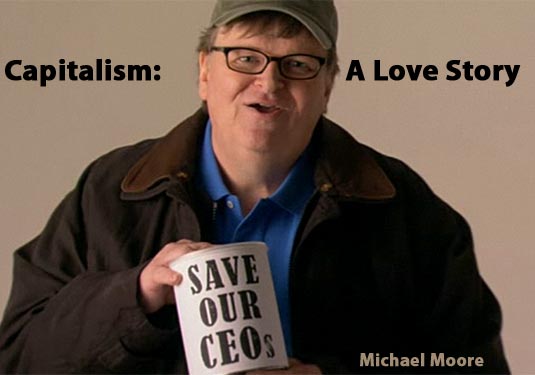
Capitalism: A Love Story
 The always controversial documentarian Michael Moore has been exposing the corruption, greed, and down-right inconsideration for the lower and middle class of America's elite for over twenty years now. Since the people who tend to support the actions and ideology behind the upper one percent are on the right side of the political fence, Moore has attacked the very basis for their position in Capitalism. Moore has even expressed that this is the film that he has been waiting to make since the beginning of his career (I'm paraphrasing). This is highly evident, as the problems of capitalism have been an underlying but influential factor in the issues discussed in his movies, even if he hasn't previously came right out and said it.
  Within the first twenty minutes, there is a montage of old-time circa-1950s footage, showing clips of the idealized yet unrealistic view of the nuclear family's American dream: dad working a factory job, mom shopping with a baby sitting in the shopping cart, the family on vacation. Over this, the narration states how things used to be good in the old days, when dad had a job that provided the family with everything they needed, mom could "work if she wanted to but didn't have to", and the middle class had a "love affair with capitalism". But soon enough, he mentions that not everything was perfect, and as long as people got to live the American dream, they would put up with "this and that", while showing clips of black men being hosed down and bombs being dropped. This is one of the more confusing parts of the film, in that I am not quite sure of what Moore is getting at. If this is the ideal version of capitalism, in which dad's job was enough to support a family and provide for their basic needs, then does he support this kind of economic system? Although he does show that things were not great for minorities and countries we had invaded at the time, this is somewhat overshadowed by the assertion that this capitalism was perverted when Reagan came into office. Moore comes dangerously close to insinuating that the 50s and 60s was a better time in American history, much like how conservatives think this was a time where family values, work ethic, and adherence to morals was at its peak, and we should therefore return to that mentality. But what they always fail to mention is the lack of rights and recognition that minorities, women, and even gays had, and this system really only benefited white middle-class males.*
My biggest bone to pick with Capitalism, and Moore specifically, is a religious aspect that incorporates in the film. He interviews several priests, who claim that capitalism is an evil and use words like "eliminate" and "eradicate" in relation to capitalism and its supporters. Christianity is supposedly highly altruistic, always looking out for the better interests of the collective, and enterprise and greed are antithetical to Jesus' principles. Moore even claims that he wanted to be a priest, but he saw them as activists pushing for social reform. First of all, I find it strange that Moore only interviews Catholic priests. I find this ironic that they are put into this context of being the ones who support the lower class, when the Vatican is a very wealthy city-state, and the reason priests can't marry has historically been because their property would go to their families instead of the Church. That sounds a lot like a product of capitalism to me. I do understand that these priests are a minority, much like the few white churches that helped out during the Civil Rights movement and the anti-war protests during the Vietnam War. But Christianity, and any other religion for that matter, has never been the poster child for social progress and reform**. Time has showed us that Christianity has consistently clung to tradition and a contradictory value system that is slowly changed in terms of peripheral beliefs as a modern world demands reform. So Moore saying that the teachings of Christianity has been at the forefront of fighting for reform and the average worker is fallacious, especially when homosexuality, a woman's right to her body, and even contraception and condoms are still condemned by most denominations. Moore fails to acknowledge the Christian/imperialist complex that is at work in America, and that he has been blaming for the past twenty years.
 However, these problems occur in the first half of the two-hour plus film. After an hour of anecdotal cases of home foreclosure and seizure, mild religious pandering, and personal stories, he finally gets to the real issue that is on everyone's mind: the financial crisis. Chronicling the beginning of the real estate loan scam that eventually and tragically ended up crashing the economy, Moore doesn't hesitate to point fingers. This is no doubt the most powerful and enraging part of the documentary, in that it shows a corporatist scam that was flawed and rotten from its very foundation.
Aside from the few problems I aforementioned, this is a compelling documentary that Moore has been working towards his whole career, whether he realizes it or not. It may not be the smoking gun that the left has been waiting for to start what the right refers to as a "commie revolution", but it will no doubt get people thinking, even if they their concern ceases the beginning of the next work day. While exposing the corruption that capitalism can potentially (and maybe even eventually) lead to, he simultaneously calls for major economic reform, namely a form of socialism, even if he doesn't say it out loud. If you hold onto the idea that America is 'great' because of capitalism, or that God wants it this way and the only alternative is a communist/socialist police state that persecutes Christians and is run by Jewish, Satanic, Catholic, homosexual, feminist, occultist, atheist (or maybe even aliens or lizards) bankers bent on world domination and destruction, then this will either enrage you or change your mind.
But I couldn't help but wonder what will become of Michael Moore now? He even states at the end of the documentary that he doesn't think that he can do this anymore. His reputation has gotten him to the point where he can no longer walk into the lobby of GM Headquarters and try to make an appointment with the CEO, like he did in Roger and Me. The second time around, in Capitalism, a security guard walks right up to him and the camera, trying to cover the lens with his hand while immediately recognizing Moore and telling him he can't shoot without permission. For Mike, it has gotten to the point where every white collar worker knows who he is and is constantly looking out for him, because of the attention he attracts and the influence he may have.
 Maybe it is time for him throw in the towel, or at least get into producing and support like-minded people looking for social justice. Or maybe he can rip the next Republican president a new asshole while making the Weinsteins a shitload of money because they think his films won't cause an uprising within a population that is largely apathetic, numbed out on trash television, and whores of the system. But with a capitalist society like ours, can you blame them for the lack of optimism?
*- This is not an admission of white guilt, nor am I saying that no white males get screwed over by capitalism
**- Again, there are always exceptions, and there is a minority that is progressive and has 'gotten with the times'
Monday, May 10, 2010
SCHLOCK! The Secret History of American Movies

What exactly does an exploitation film exploit? Is the marketing of a shitty film as a good one? Is it the use of titillating subject matter that will no doubt put some asses in the seats? Is it the name of a star that will draw attention to the film? Or is it the cast and crew, who are looking for film credits to further their career but are stuck on a low budget exploitation film that will pay them little to no money? The answer probably lies in a combination of several of these questions, if not all.
SCHLOCK! The Secret History of American Movies is a documentary directed by Ray Greene. It takes a look at the beginnings of the exploitation film, that were mostly science fiction fare like Invasion of the Saucer Men, back when science fiction was lumped in with pulp magazines. It shows the progression of how exploitation films were always looking for new material use, especially as the sexual revolution of the late 60s and 70s made people more curious about who's fucking who. The documentary features a handful of the pioneers and early players including Doris Wishman, Samuel Z. Arkoff, David F. Friedman, and the legend Roger Corman.
The problem with this feature is that has a fascination with sex. Starting off with sci-fi, it continues into the early Roger Corman horror movies, like The Terror, and his numerous Edgar Allan Poe adaptations with Vincent Price. OK, so far so good. Then it delves into the nudie film, a precursor to sexploitation films, in which relatively normal dramas and comedies take place in nudist colonies. It was subversive for the time, but since nudist colonies actually existed, they were able to get through the censors (and sex doesn't actually exist?). This eventually evolved into what are called "roughies", which focused on sex that varied from slightly rough to rape. It was around this time that I figured the documentary wouldn't get any better. Ten minutes prior, which was the fifty minute mark of a ninety minute film, they mentioned Herschell Gordon Lewis. You can imagine my disappointment when I thought they would finally stop dragging out the sexploitation concept and finally talk about the movies I wanted to hear about, the utterly twisted, depraved, gorey, and disturbing ones. Where the fuck is my Cannibal Holocaust? I Spit On Your Grave? Jesus Christ, my fucking TROMA!!!
I would have liked this more if covered anything past the early seventies, when exploitation was at its height. Having interviewed mostly directors and producers that worked in sexploitation, they most likely figured it was the easiest way to have interview footage and access to film stock that would fill up a 90-minute running time. Although disappointing, it does has some good insights. I was surprised to see Peter Bogdanovich, who played Dr. Melfi's therapist on The Sopranos, and worked with Roger Corman and Francis Ford Coppola as well as direct some movies. Probably the best insight came from Harry H. Novak (I think) who asked "What movie made today isn't an exploitation film?", which is juxtaposed to a shot of a billboard advertising Pepsi and Star Wars Episode 1 with Jar Jar Binks holding a can. Need I say more?
SCHLOCK! The Secret History of American Movies is a documentary directed by Ray Greene. It takes a look at the beginnings of the exploitation film, that were mostly science fiction fare like Invasion of the Saucer Men, back when science fiction was lumped in with pulp magazines. It shows the progression of how exploitation films were always looking for new material use, especially as the sexual revolution of the late 60s and 70s made people more curious about who's fucking who. The documentary features a handful of the pioneers and early players including Doris Wishman, Samuel Z. Arkoff, David F. Friedman, and the legend Roger Corman.
The problem with this feature is that has a fascination with sex. Starting off with sci-fi, it continues into the early Roger Corman horror movies, like The Terror, and his numerous Edgar Allan Poe adaptations with Vincent Price. OK, so far so good. Then it delves into the nudie film, a precursor to sexploitation films, in which relatively normal dramas and comedies take place in nudist colonies. It was subversive for the time, but since nudist colonies actually existed, they were able to get through the censors (and sex doesn't actually exist?). This eventually evolved into what are called "roughies", which focused on sex that varied from slightly rough to rape. It was around this time that I figured the documentary wouldn't get any better. Ten minutes prior, which was the fifty minute mark of a ninety minute film, they mentioned Herschell Gordon Lewis. You can imagine my disappointment when I thought they would finally stop dragging out the sexploitation concept and finally talk about the movies I wanted to hear about, the utterly twisted, depraved, gorey, and disturbing ones. Where the fuck is my Cannibal Holocaust? I Spit On Your Grave? Jesus Christ, my fucking TROMA!!!
I would have liked this more if covered anything past the early seventies, when exploitation was at its height. Having interviewed mostly directors and producers that worked in sexploitation, they most likely figured it was the easiest way to have interview footage and access to film stock that would fill up a 90-minute running time. Although disappointing, it does has some good insights. I was surprised to see Peter Bogdanovich, who played Dr. Melfi's therapist on The Sopranos, and worked with Roger Corman and Francis Ford Coppola as well as direct some movies. Probably the best insight came from Harry H. Novak (I think) who asked "What movie made today isn't an exploitation film?", which is juxtaposed to a shot of a billboard advertising Pepsi and Star Wars Episode 1 with Jar Jar Binks holding a can. Need I say more?
Subscribe to:
Posts (Atom)